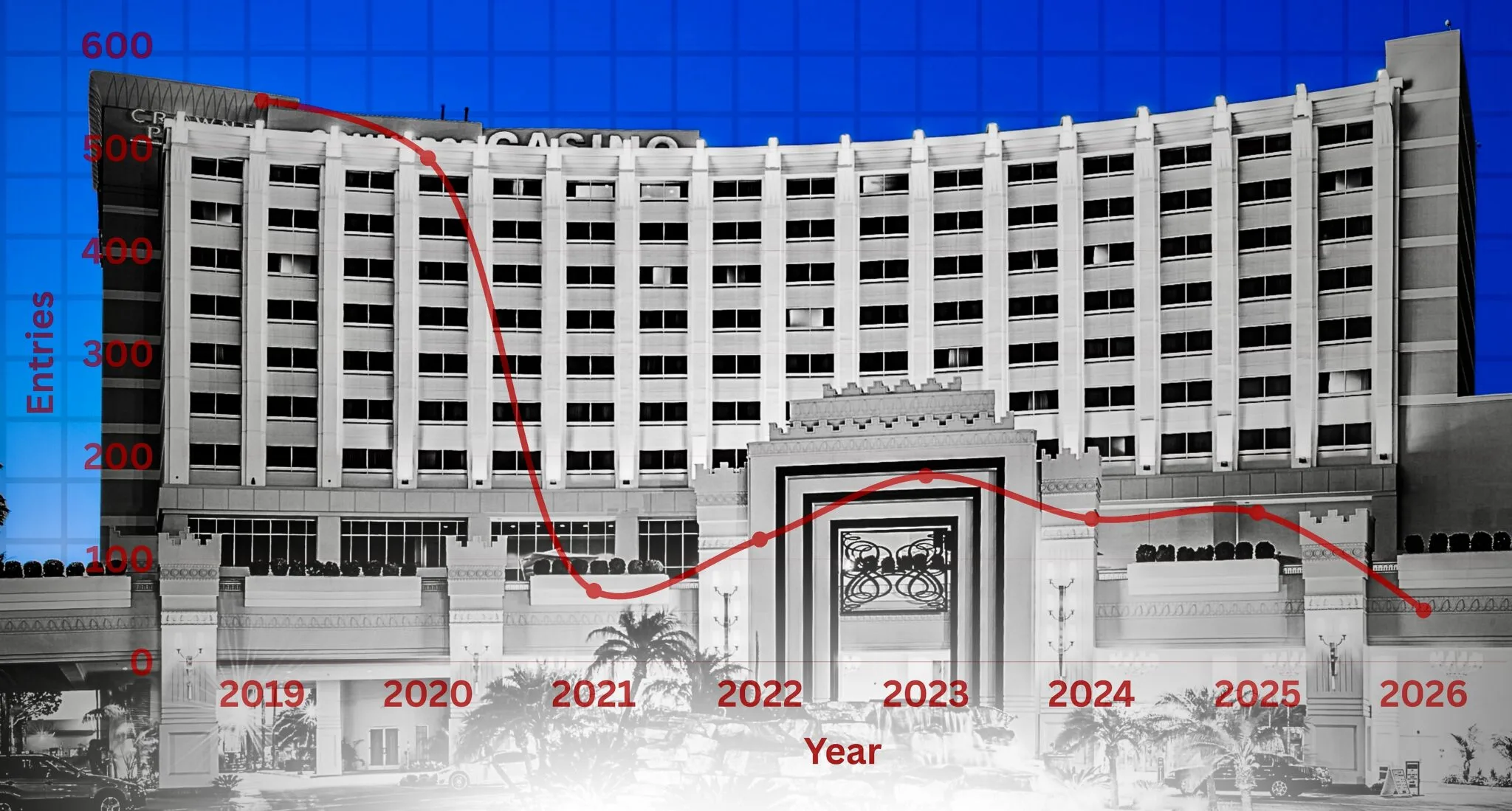
There was a time when the Los Angeles Poker Classic was appointment viewing for tournament players around the globe.
For six weeks each year, Commerce Casino transformed into a poker mecca, offering everything from mid-stakes mixed games to a star-studded championship event that rivaled anything outside the World Series of Poker in Las Vegas.
Today, that aura has faded — and the numbers tell a sobering story.
A Championship Event in Freefall
For more than 15 years, the LAPC’s $10,000 championship was a cornerstone of the World Poker Tour schedule. It routinely awarded seven-figure first prizes and drew massive fields without relying heavily on re-entries.
In 2026, that same championship drew just 50 entries — a stunning collapse for an event once won by legends like Gus Hansen, Michael Mizrachi, Phil Ivey, and Antonio Esfandiari.
Even more alarming? The modern version allows re-entries.
The broader festival reflects similar contraction. While the 2026 LAPC technically offered more guaranteed events than 2025, many of those guarantees were modest $50,000 prize pools. Overall guarantees reached $1.9 million — spread across 65 events — compared to $2.05 million across fewer, stronger events the year prior.
A Look Back at the Glory Days
Commerce launched the LAPC in 1992, cleverly positioning it after the WSOP concluded in mid-May — a scheduling sweet spot for traveling pros.
From the outset, the series wasn’t just about no-limit hold’em. Seven-card stud, lowball, limit hold’em, pot-limit Omaha, and mixed games all thrived. Early champions included Phil Hellmuth, Johnny Chan, Freddy Deeb, Barbara Enright, and Ted Forrest.
By 2002, LAPC was pioneering guaranteed prize pools — including seven-figure commitments. A year later, the championship buy-in jumped to $10,000, and Hansen captured one of the tour’s earliest WPT titles.
At its peak in 2007, the championship drew 791 entries. Even in 2011 — well past the initial poker boom — 681 players generated a $6.5 million prize pool.
Fast forward to 2026: 50 players, $465,000 prize pool.
The contrast is stark.
The COVID Aftershock and WPT Exit
The 2020 edition, played as the COVID-19 crisis loomed, attracted 490 entries — already a significant dip. Weeks later, live poker shut down.
California’s slow reopening compounded the damage. In 2021, an abbreviated LAPC ran without WPT branding. The main event drew just 69 entries, won by Michael Liang after a deal with Adam Hendrix.
The WPT partnership never resumed.
Since then, attendance has struggled to recover. Post-WPT main events peaked at 181 entries before bottoming out at 50 this year.
Broader Regional Concerns
The decline isn’t isolated to Commerce. Parkwest Bicycle Casino — better known as “The Bike” — has also experienced shrinking tournament turnouts.
Meanwhile, California cardrooms face regulatory headwinds. The state recently tightened rules governing blackjack-style games, potentially cutting into a key revenue stream. Because Commerce operates as a cardroom — not a full casino — it lacks slot machines and relies heavily on poker and approved table games.
If those revenues dip, tournament investment could shrink further.
What Happens Next?
The LAPC once thrived by adapting — choosing optimal calendar windows, embracing mixed games, pioneering guarantees, and aligning with major tours.
Now it faces existential questions:
-
Can it regain prestige without WPT backing?
-
Will regional tournament demand rebound?
-
Or will Southern California evolve into a primarily cash-game ecosystem?
Poker is healthier than ever nationwide, with expanding tours and global opportunities. Yet in a region that once defined tournament excellence outside Las Vegas, watching participation erode feels significant.
The Los Angeles Poker Classic built a legacy over decades.
Whether it can reinvent itself — or continues to drift into irrelevance — may define the future of tournament poker in Southern California.


Leave a Reply